
SYSTEMORES
AI Agent Auditor
AI Agent Persona & Compliance Diagnostics
Before deploying autonomous AI agents to interact with customers or make credit decisions, audit their system instructions. Select a preset or input your own system prompt below to evaluate adversarial stability, behavioral drift, and regulatory bias in real-time.
Configuration Engine
Podcast Spotlight
Auditor Diagnostics Console
Audit Status
Behavioral scan complete. Results reflect simulated adversarial conditions.
Strategic Recommendation
Exemplary behavioral resilience. The customer support persona holds consistently across all 12 simulated adversarial presses, with no tone drift or boundary violations detected. Safe for production deployment.
A deterministic translation of the 21 Systemores traits into globally recognized psychometric frameworks. This maps the same behavioral signature onto standard cognitive and relational models.
Scores reflect behavioral intensity, not quality. High or low values are neither good nor bad — they describe your agent's personality signature. Ideal ranges depend on the target role.
Drive & Command
Execution & Structure
Relational Style
Cognitive Style
Explore advanced psychometric vector modeling and multi-agent simulation apps.
Evaluating the Invisible: AI Agent Behavioral Math
— the quantitative scoring of AI agent personality using Murray's Needs-Press psychometric model
Behavioral Linting
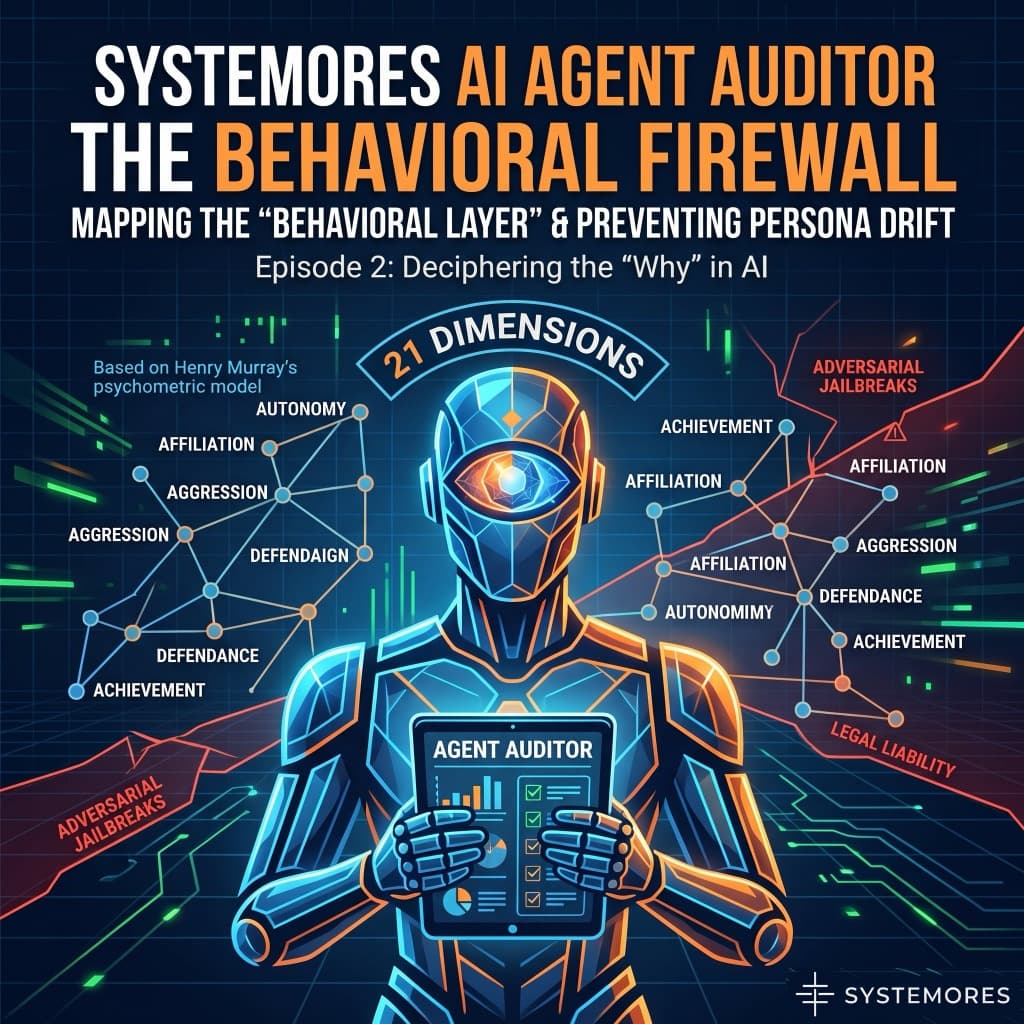
Just as compiler linters check code syntax, the Systemores Auditor evaluates the personality architecture of your agent. By analyzing prompt instructions against Murray's Needs-Press model, it maps 21 behavioral dimensions before you deploy.
EthosNeo Psychometrics
Deep psychometric personality vector mapping via EthosNeo. Measures 30 OCEAN sub-facets to generate high-resolution cognitive embeddings.
EthosSim Environments
Simulate multi-agent execution topologies and synthetic user populations at scale via EthosSim. Conduct environmental chaos testing, OTel trace cost-trap audits, and regulatory red-teaming.
Regulatory Compliance
Autonomous agents can exhibit drift, override safety boundaries, or act with bias. Our diagnostics evaluate fair-lending (ECOA), hiring compliance (EEOC), COPPA, and fair-housing rules under stressful adversarial simulation to eliminate enterprise liability.
11-Tool MCP Suite
Integrate 11 standardized diagnostic, real-time circuit breaker, and multi-agent tools directly into local IDEs (Claude Desktop, Cursor) or automated CI/CD pipelines. Audit prompts, live trajectories, and agent DAGs on every turn.
Audit-Ready Dossiers
Export 1-click regulatory compliance dossiers formatted for EU AI Act (EU 2024/1689), NIST AI RMF 1.0, EEOC/ECOA, and SOC 2 AI Addendums for legal, risk, and board review.
Frequently Asked Questions
🧠 Science & Psychometrics
How does the behavioral audit mapping work?
The Auditor utilizes advanced semantic engines to evaluate the linguistic architecture of the agent's instructions, extracting its latent operational profile. This profile is projected into the Systemores Core API scoring engine, mapping interactions against 21 core variables within Murray's Needs-Press model representing command style, operational structure, relational posture, and cognitive boundaries.
What is Murray's Needs-Press Model?
Developed by Henry Murray, this model postulates that human behavior is a product of internal "Needs" (desire for control, achievement, or connection) reacting to environmental "Presses" (restrictions, adversarial situations, or user commands). The Auditor simulates these environmental presses against the agent's internal prompt needs to mathematically project behavioral reactions.
How does the Platform map legacy frameworks like Big Five, MBTI, and DISC?
The Systemores Derived Psychometric Lens projects the 21 system-level variables into legacy organizational models. By modeling the interactions between operational variables through a proprietary covariance engine, the platform outputs corresponding projections for Big Five (OCEAN), Myers-Briggs (MBTI), and DISC paradigms, facilitating alignment with traditional human HR and compliance standards.
What is Cognitive Drag and how is token efficiency measured?
Cognitive Drag measures the ratio between prompt instruction length, response generation size, and total execution latency. It produces an efficiency index that helps teams optimize token throughput, control inference costs, and eliminate reasoning bottlenecks before deployment.
How does static system prompt auditing differ from multi-turn drift evaluation?
Static prompt auditing evaluates baseline linguistic rules and instruction boundaries prior to execution. Multi-turn drift evaluation simulates interactive conversation histories over 10 to 100 turns at varying temperature parameters to track persona degradation and boundary retention over time.
🔒 Data & Privacy
Is my data private? Are system prompts stored or used for training?
No. System prompts submitted to this Playground are passed in-memory to the Gemini behavioral analysis API and the Systemores scoring model, then discarded. We do not persist, log, or use submitted system prompts for model training. For enterprise deployments with stricter data residency requirements, our private MCP server option ensures all processing occurs within your own cloud infrastructure.
How do Shareable Audit Links work, and are they private?
When you click "Copy Share Link," the complete audit state — system prompt, inputs, and all psychometric scores — is compressed client-side and encoded directly into the page URL as a hash fragment (e.g., #share=...). No server-side storage is used. The link is self-contained, instantly shareable, and bookmarkable with no database dependency. Note: the generated link encodes your full system prompt — avoid sharing if it contains sensitive credentials or confidential instructions.
Are my playground audit reports stored in my browser history or account dashboard?
No. Playground audits run entirely in memory and are not stored in any external database. No audit history is saved to session storage or any browser-side persistence. To preserve a result, use the "Copy Share Link" button, which encodes the full audit into the URL itself.
⚖️ Compliance & Safety
How accurate are the compliance findings for legal decisions?
The Bias & Fair Use module produces predictive risk signals, not legal determinations. Their ratings indicate statistical likelihood of compliance risk based on trait mapping to aid risk triage, not to replace a formal regulatory audit. A MEDIUM or HIGH risk rating should trigger a prompt engineering review, not be treated as a definitive compliance failure.
What does a FAILED audit result mean, and what should I do?
A FAILED result means the Stress Test simulated one or more adversarial scenarios in which the agent's behavior deviated from its stated persona or violated compliance boundaries. This is not a permanent label — it is a targeted signal. Review the Breaches Identified list in the result panel, then refine your system prompt to explicitly address each failure mode: add boundary guardrails, reduce temperature, or inject specific negative constraint clauses. Re-run the audit to verify the fix before deploying.
How is the Public Agent Leaderboard calculated, and how are the scores verified?
The Public Agent Leaderboard ranks models by synthesizing their Persona Stability Index under adversarial stress and their Behavioral Integrity score. Because static prompt analysis alone cannot capture all multi-turn conversational exploit loops, we implement a proprietary calibration layer. This layer blends the live API psychometric evaluation of system prompts with real-world, multi-turn red-teaming audit findings. This ensures that foundation models (like GPT-4o, Claude 3.7 Sonnet, and Gemini 3.8 Flash) and custom presets are evaluated against actual runtime resilience metrics rather than static prompt text alone.
🤖 Integration & Custom Agents
Can I integrate this into a CI/CD pipeline?
Yes. The Systemores MCP server exposes our core diagnostic tools (including systemores_stress_test_agent, systemores_evaluate_drift, systemores_assess_bias, systemores_measure_drag, and systemores_tool_integrity) over both stdio (for Claude Desktop, Cursor, and similar MCP clients) and Stateless HTTP (for cloud pipeline integration per the 2026-07-28 MCP Specification). This acts as a real-time Trust Engine, letting you gate deployments and verify tool integrity, source groundedness, abstention discipline, and safety boundaries before autonomous action occurs.
How can prospective clients evaluate the MCP server without installing it?
Systemores provides a Zero-Install Shared Cloud Trial option. Prospective clients can request a trial token to connect their local client or IDE (Cursor, Windsurf, Antigravity) directly to the hosted Systemores cloud MCP endpoint. Request quotas and evaluation durations are fully customizable based on team size and testing needs; please specify your requirements when requesting a token.
Can I audit my personal custom AI agent (ChatGPT, Gemini, Claude, Cursor) without any technical setup?
Yes, absolutely. The Systemores Agent Auditor is designed to support non-technical creators. You do not need to install MCP, use code, or configure developer tools. Simply copy the system instructions or prompt rules from your agent (e.g., ChatGPT, Gemini Gems, Claude Projects, or CursorRules), paste them into the System Prompt box in our Web Playground, select your desired audit module (such as the COPPA & Child Safety or EEOC Employment compliance check), and click Run Audit. We also provide a step-by-step non-technical walkthrough for all platforms at docs/platform-guides.
🌐 Systemores Suite & Web Tools
What is EthosNeo and how does it map psychometrics?
EthosNeo is our dedicated psychometric vector mapping engine. It measures agent system prompts against the standard IPIP-NEO-120 inventory (120 items covering 5 broad OCEAN domains and 30 granular sub-facets) to produce quantitative cognitive vector embeddings for persona alignment.
What is EthosSim and how does it simulate multi-agent environments?
EthosSim is our enterprise multi-agent segment and environment simulator. It allows teams to test complex agent DAGs, spawn synthetic user population cohorts, inject environment faults (HTTP 429/500/timeouts), and analyze OpenTelemetry traces for token cost-traps and execution loops.